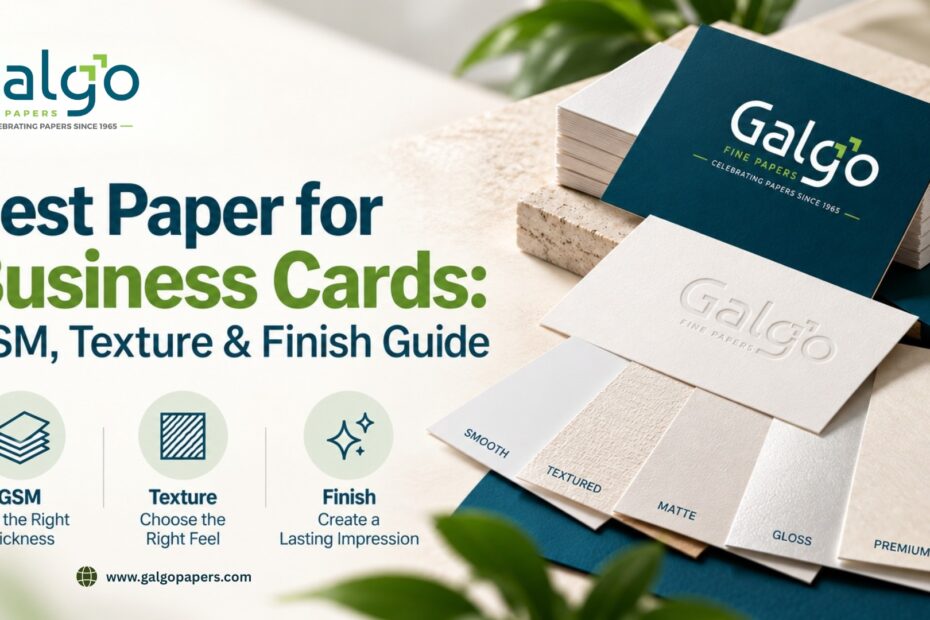
A business card does more than carry a name, phone number, email address or logo. The paper itself contributes to how the card looks, feels and represents a brand. For that reason, choosing the best paper for business cards involves more than selecting the highest GSM available.
The right choice depends on several factors, including GSM, thickness, bulk, surface texture, coating, finish, printing method and post-press finishing. A smooth coated stock may be suitable for sharp, colour-rich graphics, while an uncoated or textured specialty paper may be a better fit when tactile character is central to the brand.
There is no single paper that is best for every business card. The right paper is the one that matches the brand identity, artwork, printing process and desired finish.
This guide explains how to evaluate business card paper and how to choose between smooth, coated, uncoated and textured options for professional and premium branding.
What Is the Best Paper for Business Cards?
The best paper for a business card depends on the desired appearance, feel, printing requirements and finishing techniques.
For a clean corporate card with detailed graphics and strong colour reproduction, a suitable coated or smooth stock may be appropriate. For a more tactile, distinctive or traditional identity, an uncoated or textured specialty paper can create a different brand experience.
When selecting business card paper, consider:
- GSM and actual sheet thickness
- Bulk and stiffness
- Coated or uncoated surface
- Smooth or textured finish
- Colour and shade of the paper
- Printing process
- Embossing or debossing requirements
- Foil-stamping requirements
- Whether the recipient needs to write on the card
- The overall visual and tactile identity of the brand
The important point is that higher GSM does not automatically mean better paper. GSM measures the weight of paper per square metre. Thickness, stiffness and bulk can vary between different paper grades at the same GSM.
What GSM Is Best for Business Cards?
There is no universal GSM that is best for every business card.
Business cards are commonly produced on heavier paper stocks than everyday office stationery because the card needs to withstand handling and maintain a firm, substantial feel. However, the appropriate GSM depends on the paper grade, construction, printing method and finishing requirements.
A useful way to think about GSM is:
GSM tells you how much the paper weighs; it does not, by itself, tell you exactly how thick or stiff the finished card will feel.
Two papers with the same GSM can feel noticeably different because their fibre structure, bulk, coating and manufacturing characteristics may differ.
For this reason, buyers should evaluate GSM together with thickness, bulk and physical samples rather than selecting a business card stock based on GSM alone.
GSM vs Thickness vs Bulk: What Is the Difference?
These terms are often used interchangeably, but they describe different characteristics.
GSM refers to the mass of paper per square metre.
Thickness refers to the physical caliper of the sheet.
Bulk describes the relationship between a paper’s thickness and its weight. A high-bulk paper can feel more substantial without necessarily having an exceptionally high GSM.
This distinction matters when specifying premium business cards. A card can feel substantial because of its paper construction and bulk, not simply because it has the highest possible GSM.
Before a large production run, ask the paper supplier or printer for the relevant technical specifications and, where possible, evaluate a physical sample.
Coated vs Uncoated Paper for Business Cards
The choice between coated and uncoated paper changes both the visual and tactile character of a business card.
Coated Paper
Coated papers have a treated surface designed to provide controlled ink holdout and a smoother printing surface. Depending on the finish, coated paper can support crisp graphics, strong colour reproduction and image-heavy designs.
Coated business card stocks can work well when the design depends on:
- Detailed graphics
- Strong colour contrast
- Photography
- Smooth surfaces
- A contemporary visual appearance
The specific coating and finish should still be tested with the chosen printing process and artwork.
Uncoated Paper
Uncoated papers do not have the same surface coating used on coated grades. They generally provide a more natural paper feel and can be particularly appropriate when tactile character, understated design or writability is important.
Uncoated specialty papers are commonly used for applications where the material itself contributes to the identity of the printed piece.
Galgo’s Contrast Laid, for example, is described as an uncoated paper with strong sheet formation and applications including business stationery, corporate brochures, folders and invitation cards.
The choice therefore should not be framed as coated versus uncoated being universally better. The better option depends on the purpose of the card.
Textured vs Smooth Paper for Business Cards
Texture can make a business card more distinctive because it introduces a physical element that cannot be communicated fully through a digital design proof.
Textured paper can work particularly well for brands that want to communicate:
- Craftsmanship
- Heritage
- Exclusivity
- Creativity
- Natural character
- A tactile brand identity
Smooth paper, meanwhile, can provide a cleaner and more understated surface for minimalist corporate identities and detailed graphic designs.
The texture should complement the artwork rather than compete with it. Fine typography, logos and small details may require testing on the actual stock before production.
Galgo Specialty Paper Options
Galgo’s current collection includes specialty and fine-paper grades such as Contrast Laid, Contrast Natural, Classic, Leathack and Soft Touch, among other papers.
The individual products have different characteristics and application profiles, so they should be selected according to the project rather than presented as interchangeable business-card papers.
For example, Galgo describes Classic as a textured, high-bulk uncoated paper with a handmade-paper feel and lists business stationery among its applications.
Leathack is an embossed specialty paper with leather-patterned textures and is described for applications including stationery, book covering, box covering, folding boxes, shopping bags and tags.
These distinctions are important when choosing paper for a particular brand application.
Which Paper Is Best for Premium Business Cards?
For premium business cards, the best paper is not necessarily the heaviest stock. Instead, consider how the paper surface, texture, colour, bulk and finishing work together.
A premium business card might use:
- A tactile uncoated specialty paper
- A distinctive textured surface
- A smooth coated stock
- A high-bulk paper
- Foil stamping
- Embossing or debossing
- A carefully selected paper colour or shade
The correct combination depends on the identity the brand wants to communicate.
For a traditional professional identity, a subtle textured or uncoated paper may create a restrained, tactile result. For a contemporary brand using photography or strong colour, a smooth surface may provide a more appropriate foundation.
What Paper Is Best for Embossed Business Cards?
Embossing creates a raised design or detail by physically deforming the paper. The paper therefore needs to be compatible with the intended finishing process.
Uncoated specialty papers can be particularly interesting for tactile embossing because the paper itself already contributes texture and character. However, the exact result depends on the paper, thickness, die design, embossing depth and production process.
Do not specify an embossing paper solely by GSM.
Before production, ask the printer or paper supplier to conduct a press test if the embossing is an important part of the design.
What Paper Is Best for Foil-Stamped Business Cards?
Foil stamping applies metallic or pigment foil to a printed surface using heat, pressure and a die.
The best paper for foil stamping depends on the foil system, paper surface, colour, texture and required level of detail.
Smooth stocks can provide a clean, crisp foil appearance, while textured stocks can produce a more tactile result. However, not every textured paper behaves identically during foil stamping.
This is why foil compatibility should be confirmed with the paper supplier and printer before a production order.
For specialty papers, a physical foil test is often more useful than relying solely on a digital mock-up.
How Paper Finish Changes the Look of a Business Card
Paper finish affects how light interacts with the card and how the printed design is perceived.
A smooth surface can make detailed typography and graphics appear clean and controlled.
A textured surface introduces visual and tactile variation.
A matte surface can reduce reflections and create a restrained appearance.
A more reflective finish can increase visual impact and colour intensity, depending on the stock and printing process.
The finish should therefore support the brand’s visual language.
A luxury jewellery company, architectural practice, law firm, fashion label and technology company may all require different paper characteristics even if their cards contain the same basic information.
How to Choose Business Card Paper for Your Brand
Instead of starting with GSM, start with the brand and application.
1. Define the desired brand impression
Ask whether the card should feel:
- Minimal
- Corporate
- Traditional
- Contemporary
- Luxury
- Creative
- Natural
- Tactile
2. Choose the surface
Decide whether the project needs:
- Smooth
- Textured
- Coated
- Uncoated
- Soft-touch
- Embossed or otherwise finished stock
3. Consider the printing process
Paper should be tested with the intended printing process. Colour reproduction and surface behaviour can vary between paper grades.
4. Consider finishing
If the design includes embossing, debossing or foil stamping, select a stock that has been tested for the required finishing process.
5. Evaluate physical samples
A screen cannot reproduce paper texture, thickness, stiffness or tactile character accurately.
Always request a physical sample where the paper choice is important to the brand experience.
6. Review the complete brand system
If the business card is part of a larger corporate identity, consider whether the same paper family or complementary stocks should be used for:
- Letterheads
- Envelopes
- Folders
- Certificates
- Invitations
- Presentation materials
- Brand collateral
This creates greater consistency across physical brand touchpoints.
Business Card Paper Should Match the Brand, Not Just the Budget
The cheapest paper is not necessarily the right paper, but the most expensive paper is not automatically the best choice either.
A successful specification balances brand identity, print requirements, tactile experience, finishing, availability and project budget.
For example, a highly textured paper may be appropriate for a design studio but unnecessary for a conservative corporate identity. Similarly, a highly smooth coated stock may be useful for a colour-intensive design but less appropriate when the card’s tactile character is the main point.
The objective is not to make the card as heavy or elaborate as possible. It is to select a paper that makes the finished card feel consistent with the brand.
Why Physical Paper Samples Matter
Paper is a physical material, so a digital screen cannot fully communicate its surface, texture, stiffness or tactile quality.
A proper sample review can help you evaluate:
- Actual colour
- Surface texture
- Paper thickness
- Bulk
- Stiffness
- Print appearance
- Foil response
- Embossing response
- Writing behaviour
- Overall brand impression
For a significant business-card or corporate-branding project, sampling before bulk production can reduce the risk of choosing a paper that looks right on screen but feels wrong in the finished piece.
Choosing Specialty Paper for Business Cards with Galgo
Galgo Fine Papers supplies a range of fine and specialty papers for print, stationery, branding and packaging applications. Its current collection includes uncoated, textured, coated, recycled and specialty grades.
Among the grades relevant to corporate and specialty print applications, Contrast Laid is listed for business stationery and corporate brochures, while Classic is listed for business stationery and other premium applications.
The right selection should be based on the required GSM, texture, finish, printing method, finishing process and final application.
For projects where paper selection is central to the brand identity, requesting samples before production allows designers, printers and brand teams to compare the physical options rather than making the decision from screen images alone.
Quick Business Card Paper Selection Guide
| Requirement | What to consider |
| Corporate and understated | Smooth or subtly textured stock |
| Luxury and tactile | Specialty textured or high-bulk uncoated stock |
| Strong colour and graphics | Suitable coated or smooth stock |
| Natural or handcrafted identity | Uncoated or textured stock |
| Embossed logo | Confirm embossing compatibility and test |
| Foil-stamped logo | Confirm foil compatibility and test |
| Minimalist branding | Paper texture and shade can become the main design element |
| Consistent corporate identity | Consider the paper across cards, stationery and folders |
The best paper for business cards is not determined by GSM alone.
A strong business-card specification considers GSM, thickness, bulk, surface, texture, coating, colour, printing process and finishing requirements together.
For a premium result, begin with the brand identity and intended application. Then compare suitable paper samples and test the printing and finishing processes before committing to a production run.
For designers, printers and brands, this approach turns paper selection from a last-minute production decision into part of the overall brand strategy.
Frequently Asked Questions
What is the best GSM for business cards?
There is no single GSM that is best for every business card. The appropriate GSM depends on the paper grade, thickness, bulk, printing process, finishing requirements and desired feel. Evaluate GSM together with physical samples rather than using weight alone as the quality benchmark.
Is higher GSM always better for business cards?
No. Higher GSM means greater paper weight, not automatically better quality. A high-bulk uncoated specialty paper at 300 GSM can feel more substantial than a standard coated stock at 350 GSM. Evaluate GSM together with bulk, thickness, and physical samples rather than using weight as the sole quality benchmark.
Which is better for business cards: coated or uncoated paper?
Both can be suitable. Coated paper can provide a smooth surface and controlled ink reproduction, while uncoated paper can provide a more natural, tactile feel. The right choice depends on the design, brand identity and intended finish.
Is textured paper good for business cards?
Yes, textured paper can be an effective choice when tactile character is important to the brand. It is particularly useful for distinctive corporate identities, luxury branding, creative businesses and stationery. The texture should be tested with the intended printing and finishing process.
What paper is best for embossed business cards?
The appropriate paper depends on the embossing design, depth, paper construction and production method. Rather than choosing based on GSM alone, confirm embossing compatibility with the printer or paper supplier and conduct a physical test for important projects.
Can textured paper be used for foil stamping on business cards?
Yes. Galgo Fine Papers’ Contrast Laid range has been tested for foil compatibility and performs reliably when the correct foil temperature and dwell parameters are applied. Not all textured papers accept foil equally always confirm compatibility with your supplier before production.
Should I choose the same paper for business cards and corporate stationery?
Not necessarily, but using complementary papers can create consistency across a corporate identity. Business cards, letterheads, folders and other materials have different functional requirements, so the paper should be selected according to both brand identity and application.
Should I see a paper sample before ordering business cards?
Yes. A physical sample is strongly recommended for premium or specialty business cards because screens cannot accurately reproduce paper texture, thickness, stiffness and tactile feel. Sampling also allows the printer to test colour reproduction and finishing before the full production run.
Where can I buy specialty paper for business cards in Delhi NCR?
Galgo Fine Papers at 27 Phase 2, Pocket W, Okhla Phase II, Okhla Industrial Estate, New Delhi, Delhi 110020 supplies specialty, textured, coated, and FSC certified papers for business cards and brand stationery to designers, printers, and corporate buyers across Delhi, Noida, Gurugram, Faridabad, Greater Noida, and pan-India. Contact us at connect@galgofinepapers.com or call +91-9811949773.